
How to calculate concrete for deck post footings
Measure the inside diameter and filled height of each concrete pier on your deck plan. Calculate its cylinder volume, then add a separate round or square base if the detail includes one. Multiply by the number of matching footings, combine any second footing size, and apply your extra allowance. Finally, divide by the yield printed on your concrete mix bag and round up to whole bags.
The deck post is not subtracted. In the post-base arrangement covered here, the post sits on a connector above the concrete. This differs from a fence post set inside a concrete-filled hole, where the embedded post displaces some concrete.
Bag counts use the concrete yield printed on the mix bag. The project total rounds up once after combining the footings. If you mix one footing at a time and cannot use a partly mixed bag in the next pour, use the per-footing count instead.
The formulas behind the estimate
- Round pier
- π × (diameter ÷ 2)² × filled height
- Round base
- π × (base diameter ÷ 2)² × thickness
- Square base
- base width² × thickness
- Project volume
- sum of [(pier + base) × count] for each group
- Project bags
- round up [(project volume × (1 + extra % ÷ 100)) ÷ yield per bag]
With inch inputs: divide in³ by 1,728 for ft³; 27 ft³ = 1 yd³. Base volume is zero for a straight pier. Use the same volume unit for the project and bag yield.
Where to measure the footing
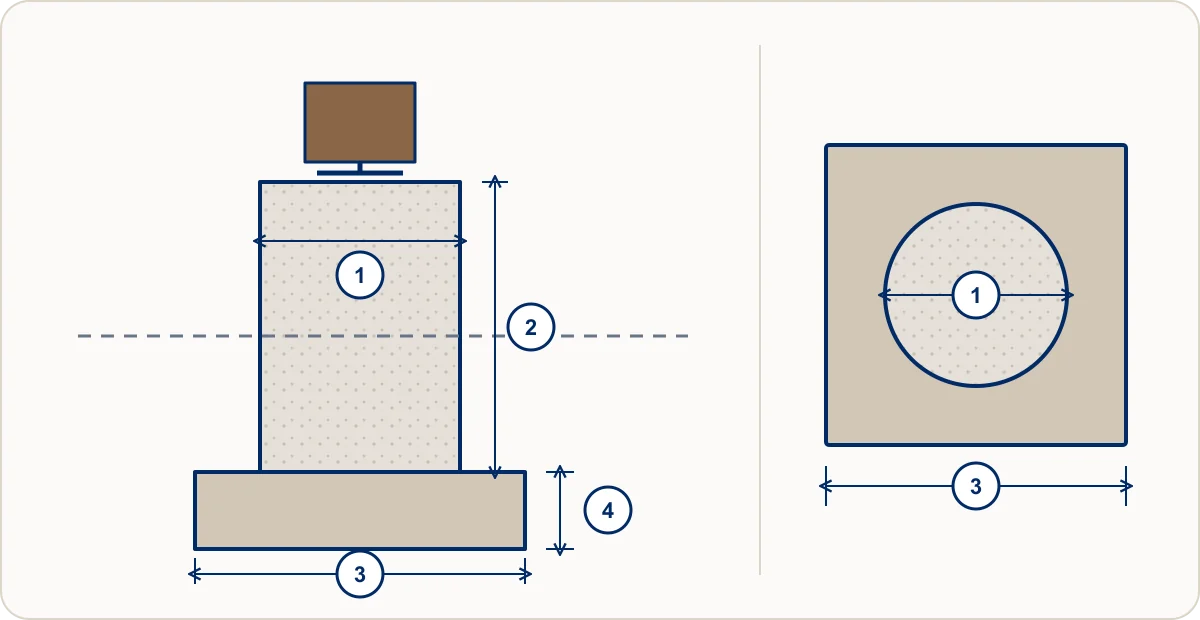
- Inside diameter of the pier
- Filled height of the pier
- Width or diameter of the base
- Thickness of the base
The side view is on the left and the top view is on the right. Measure pier height from the top of the base so its thickness is counted once. The post sits above the concrete.
Worked example: four round deck piers
Four piers, each 12 inches in diameter and 36 inches high, need π × 0.5² × 3 = 2.36 cubic feet each, or 9.42 cubic feet total. With 5% extra, plan for 9.90 cubic feet (0.37 cubic yards). At an estimated 0.60 cubic feet per 80 lb bag, that is 17 whole bags for a shared project pour. Check the yield of your actual mix.
Example with a wider square base
Suppose the plan calls for four 12-inch-diameter piers, each filled 36 inches high, on separate 24-inch-square bases that are 8 inches thick. Each pier takes about 2.36 ft³ and each base takes 2.67 ft³. Together that is about 20.09 ft³ for four footings. With 5% extra, order about 21.10 ft³ (0.78 yd³), or 36 bags if the mix yields 0.60 ft³ per bag. The 36-inch pier height starts above the base.
Which dimensions belong in the calculator?
Start with the footing detail on your deck plan. For a formed pier, use the form's inside diameter and measure the concrete from the bottom of that pier to the finished top, including any part above grade. If a wider base sits below it, enter that base as a separate shape. The pier height starts at the top of the base, so its thickness is counted only once. A post bracket above the pour does not change the concrete volume.
These base options assume a flat bottom, straight sides and one thickness. A tapered bell footing, stepped detail or irregular excavation needs a calculation for its actual shape. Do not use the widest base diameter for the whole pier depth.
Using the result to buy concrete
The exact volume is the space inside the footing shapes. The order volume adds the percentage allowance you entered. Bags for the full project are rounded up after combining both footing groups, which assumes you can use leftover mix across pours. If each footing will be mixed separately, check the bags-per-footing result and plan for whole bags at each one.
For a ready-mix enquiry, use the cubic-yard order volume and ask the supplier about its minimum delivery and site access. For bags, use the stated yield of the concrete mix you will actually buy; different products of the same weight may yield different volumes. Make sure that mix matches the footing specification on your plan.
How the ZIP-based price guide works
Entering a ZIP code checks the state. The guide uses published US prices for 80 lb concrete mix and a separate reference count at about 0.60 ft³ per bag. The same US price examples apply across ZIP codes because we do not have verified store prices by ZIP. This is a planning range, not a live price at a nearby store.
If you know the price of the concrete mix you will buy, enter it in the optional price-per-bag field. That result uses the whole-bag count for your selected mix yield. Compare either figure with the supplier's actual price, product suitability, tax and delivery. ZIP and price inputs never change the footing volume or bag count.
Retail examples checked September 30, 2026: Home Depot, Ace Hardware.
What this estimate does not decide
- Footing diameter, depth and count depend on loads, soil bearing, frost conditions and local requirements. Use an approved plan or your building authority's detail.
- Concrete strength, reinforcement, anchor hardware and curing requirements come from the project specification, not a volume calculator.
- An enlarged or collapsed hole can take more concrete than the neat shape on the drawing. Measure the actual formed dimensions again before ordering if the excavation changes.
Common questions
How many bags of concrete do I need for a deck post footing?
Enter the number of footings and the dimensions from your deck plan. The calculator divides total concrete volume, including your selected extra allowance, by the bag's stated yield and rounds up to whole bags. Check the exact product label; bag weight alone does not determine yield.
Does this calculator tell me what size deck footing to build?
No. Footing diameter, depth, thickness, post count and connection details depend on deck loads, soil, frost conditions and local requirements. Use dimensions from an approved plan or local building authority.
Do I subtract the deck post from the concrete volume?
For the common post-base detail, the wood post sits above the concrete on an approved connector. The post does not displace concrete inside the pier, so this calculator fills the entire pier and base.
Can I calculate a wider base below a Sonotube pier?
Yes, if the base has straight sides and a consistent thickness. Choose a round or square base, then enter its width and thickness separately from the narrower pier. A tapered or bell-shaped base needs its own volume calculation.
What if my deck has two footing sizes?
Add a second footing group with its own count, pier dimensions and optional wider base. The calculator combines both groups before rounding the project bag count, so leftover mix can be used across pours.
Does my ZIP code give an exact concrete bag price?
No. It checks the state, while the material range uses published US prices for 80 lb concrete mix. It is not a live store price. Enter your own bag price for the mix you plan to buy.