
How to calculate deck footing concrete volume
Read the finished pier diameter and filled height from the structural drawing. Add a separate round or square pad only if the detail shows one, and count the pad thickness once. Multiply by the number of footings and add the volumes of any second size. The cubic-metre result includes your chosen allowance and can be used for a ready-mix enquiry. Enter a bag yield only for a complete premixed concrete product.
The formulas behind the estimate
- Round pier
- π × (diameter ÷ 2)² × filled height
- Round base
- π × (base diameter ÷ 2)² × thickness
- Square base
- base width² × thickness
- Project volume
- sum of [(pier + base) × count] for each group
- Project bags
- round up [(project volume × (1 + extra % ÷ 100)) ÷ yield per bag]
With millimetre inputs: 1,000,000 mm³ = 1 L and 1,000 L = 1 m³. Base volume is zero for a straight pier. Use the same volume unit for the project and bag yield.
For posts embedded inside concrete-filled holes, use ourfence post concrete calculator.
Concrete quantity from the drawing
Read the pier diameter and filled height from the structural footing detail. If a wider pad is specified, enter its width and thickness as a separate shape. The post connection above concrete does not take up the pier's volume. This tool supplies quantity, not a concrete grade or reinforcement design.
Where to measure the footing
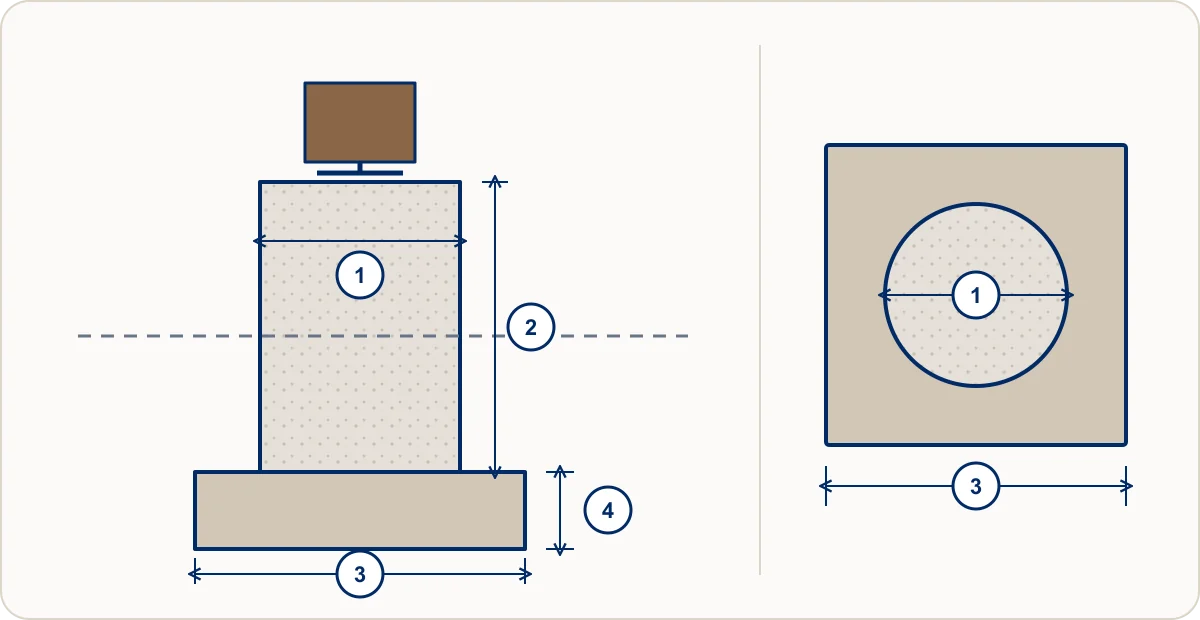
- Inside diameter of the pier
- Filled height of the pier
- Width or diameter of the base
- Thickness of the base
The side view is on the left and the top view is on the right. Measure pier height from the top of the base so its thickness is counted once. The post sits above the concrete.
Example: four piers
Four piers 300 mm in diameter and 1,000 mm high need about 283 L before allowance. Five percent extra brings the planning volume to about 297 L, or 0.297 m³. Use this m³ figure for a ready-mix enquiry; a bag count requires the yield of a complete premixed product.
Keep the quantity separate from the mix design
Use the structural detail to identify the finished pier diameter, filled height, and any wider pad. Count the pad thickness once, below the pier. If the site excavation is irregular or the footing slopes, ask the engineer or contractor for a takeoff based on the actual shape. This calculator does not choose footing dimensions, reinforcement or concrete grade. Those remain on the drawing and should not be inferred from the volume result.
Use cubic metres for site batching or RMC
The net volume is the space to fill; the order volume adds your chosen allowance. Take that cubic-metre figure to a ready-mix supplier and check the specified grade, delivery minimum and site access. For concrete batched on site, give the volume to the person responsible for the approved mix. Leave the bag-yield field empty unless you are buying a complete premixed concrete product with a stated yield. A 50 kg cement bag cannot be converted into a fixed concrete volume without a mix design.
Reading the PIN-based ready-mix range
For India, the local guide uses the order volume in cubic metres and an indicative M20 ready-mix rate, not a number of cement bags. A PIN can identify a city with a published M20 ready-mix rate. Other PINs use the published India-wide M20 range. This is only a material planning range; the grade on your structural drawing may differ from M20.
Ask an RMC supplier about the specified grade, delivery minimum, pumping, taxes and access before treating the range as a budget. If you buy complete premixed concrete in bags, enter that product's stated litre yield and your price per bag instead. A cement-only bag price cannot be multiplied by the tool's premix bag count.
Price benchmark (30 Sep 2026): AECORD.
Ordering in India
Check the specified concrete grade, footing dimensions and site access with your engineer or contractor. A 50 kg cement bag has no fixed equivalent volume of finished concrete: sand, aggregate, water and mix design determine the yield. Do not use a cement-bag count as a premix-bag estimate.
Common questions
Can I enter 50 kg cement as a bag of concrete?
No. The bag input requires the mixed-concrete yield of a complete premixed product. Use cubic metres for site batching or ready-mix.
Does the calculator choose an M-grade?
No. Follow the grade and footing design given by your engineer or approved drawing.