
How to work out concrete for deck footings
Start with the pier diameter and filled height on your footing schedule. For a wider round or square pad, calculate that pad on its own and add it to the pier. Multiply each detail by its footing count, then combine the groups before adding your selected allowance. Use the cubic-metre total for a ready-mix enquiry or divide the litres by the yield of your chosen bagged mix.
The formulas behind the estimate
- Round pier
- π × (diameter ÷ 2)² × filled height
- Round base
- π × (base diameter ÷ 2)² × thickness
- Square base
- base width² × thickness
- Project volume
- sum of [(pier + base) × count] for each group
- Project bags
- round up [(project volume × (1 + extra % ÷ 100)) ÷ yield per bag]
With millimetre inputs: 1,000,000 mm³ = 1 L and 1,000 L = 1 m³. Base volume is zero for a straight pier. Use the same volume unit for the project and bag yield.
For posts embedded inside concrete-filled holes, use ourfence post concrete calculator.
Using a deck footing schedule
Match each footing type to its diameter, pier height and any wider pad dimensions. The tool treats the pier and pad as adjacent filled shapes. Where the post is attached to the top of concrete, no post volume is removed. A bored hole with a different specified detail needs its actual filled dimensions.
Where to measure the footing
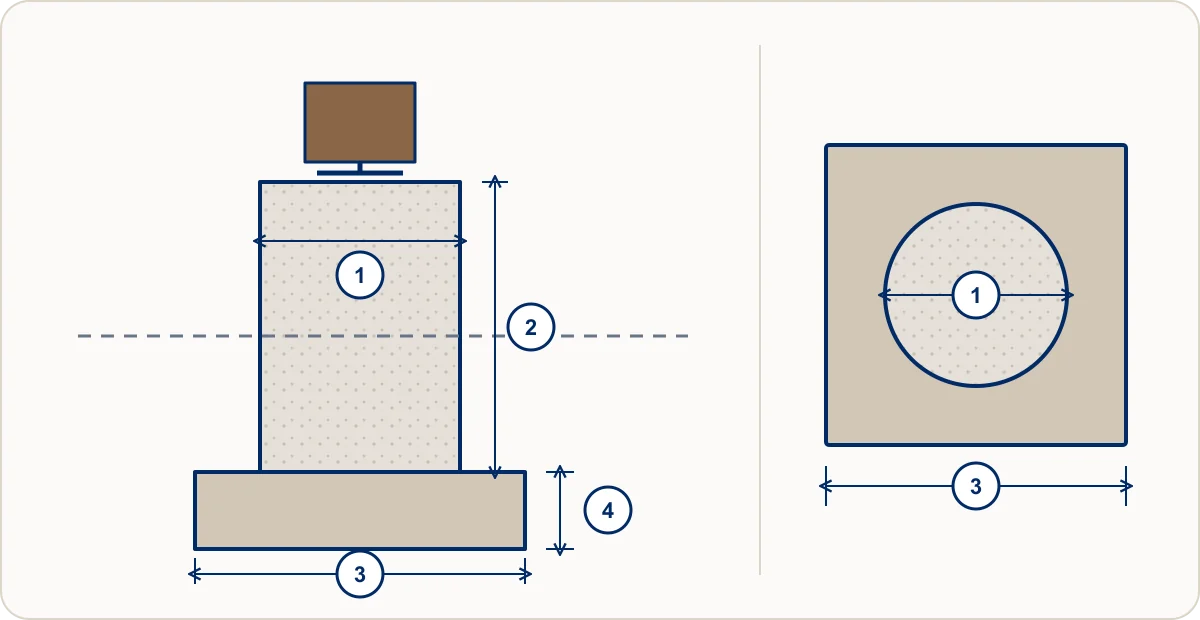
- Inside diameter of the pier
- Filled height of the pier
- Width or diameter of the base
- Thickness of the base
The side view is on the left and the top view is on the right. Measure pier height from the top of the base so its thickness is counted once. The post sits above the concrete.
Example: a six-pier deck
Six 300 mm round piers, each filled to 900 mm, use about 382 L before allowance. At 5% extra, plan roughly 401 L (0.401 m³). With a 9.5 L yield per 20 kg bag, as listed for one Australian premix, this is 43 bags.
Take the sizes from the footing schedule
Deck footing details can vary between posts on the same job. Count each repeated detail, then use the second group when another pier or pad size appears on the schedule. For a pier on a pad, measure the pier from the pad’s top surface upward and enter the pad thickness once. The square-pad option assumes straight sides, as shown in the image. If the excavation or footing tapers, use its actual specified shape rather than treating the widest dimension as a full-depth pad.
Turn litres into a purchase quantity
The net volume is the geometric amount inside the forms. The allowance covers small losses or measurement differences you choose to allow; it does not change the footing design. The cubic-metre number is useful for a ready-mix enquiry. For bagged premix, check the yield of the product that meets your concrete specification. One Australian 20 kg mix lists 9.5 L per bag, but another blend may differ. Compare the whole-project bags with the per-footing count if pours will be separate.
How the postcode price guide is built
A postcode identifies a state or territory for the price guide. The displayed range starts with published prices for 20 kg concrete mix and a separate bag count at the reference yield of about 9.5 L. The postcode checks the state or territory but does not change the published Australian price examples. The guide cannot check the price or stock at a particular Bunnings store.
For the mix you actually plan to use, enter its yield and the price you find locally. That produces a bag material cost for your selected product. Delivery and ready-mix minimums need separate quotes, especially when the footing schedule calls for many piers. The location input does not change concrete volume.
Retail examples (30 Sep 2026): Bunnings.
Check the drawing first
Your footing schedule and local building requirements determine sizes and reinforcement. This volume tool does not design the footing. Compare the calculated m³ with ready-mix minimum orders and confirm the concrete mix meets the job specification.
Common questions
Can I include a square pad under a round pier?
Yes. Choose square pad and pier, then enter the pad width and thickness separately.
Are these bag counts exact for every 20 kg mix?
No. A bag's yield depends on the product. Enter the litre yield printed on the mix you intend to use.