Fence Post Concrete Calculator
Work out how much concrete your fence-post holes need — and how many bags to buy — accounting for post displacement and a gravel base.

By Berjin B V
Published Updated
- Calculated posts
- —
- Concrete depth (per hole)
- —
- Hole volume (per hole)
- —
- Post displacement (per hole)
- —
- Net concrete (per hole)
- —
- Total concrete
- —
- Equivalent bags
- —
- Approx. bags per hole
- —
- Recommended purchase
- —
- Total bag weight
- —
Request a Free Fencing Quote
Tell us about your fencing project and location. We'll prepare a quote and send it to you when it's ready — Buildmator prepares these manually, and there's no obligation.
Request a Free Fencing QuoteNot a structural specification
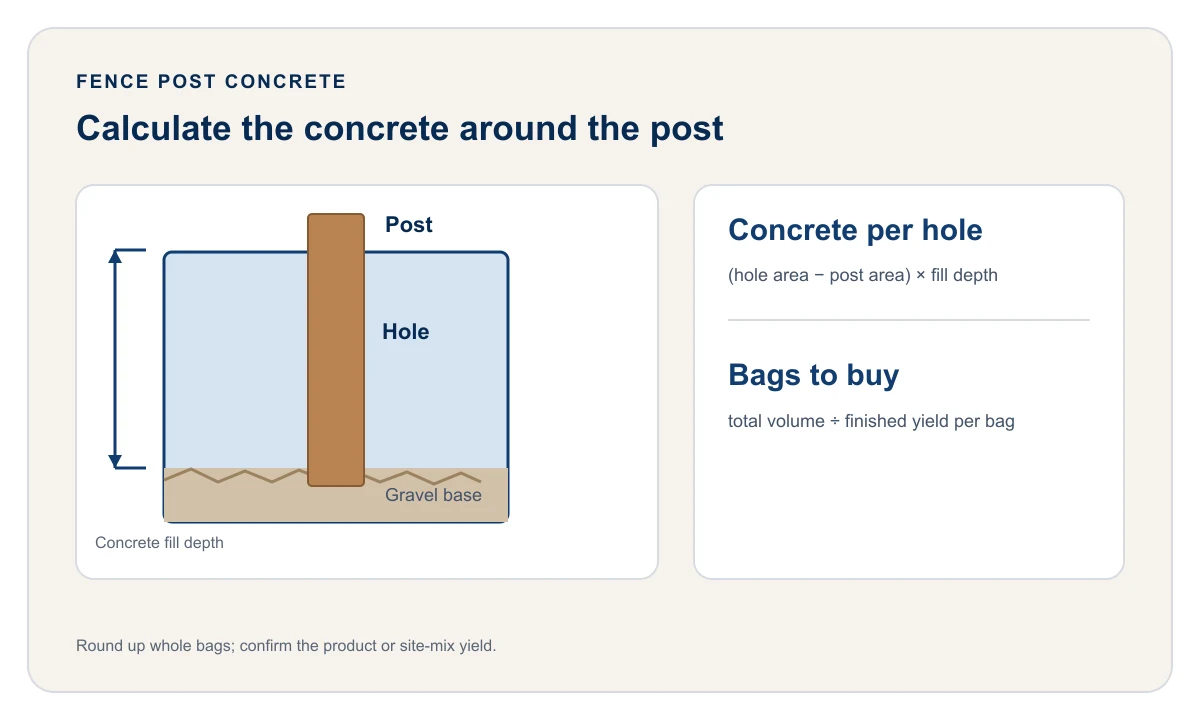
Work out exactly how much concrete your fence-post holes need — as a precise volume in litres, an “equivalent bags” figure, and a whole-bag shopping list that won’t leave you short mid-pour. This is a material quantity calculator: it doesn’t price concrete, size your holes, or check that a fence design is structurally sound.
How to use this calculator
- Measurement units — metres / millimetres (default) or feet / inches. Switch any time; your numbers convert automatically.
- Post count — enter it directly, or choose Calculate from fence length and spacing and give the run length and target spacing; the post count updates live.
- Hole shape and size — round (diameter) or square (width), plus total hole depth and an optional gravel base depth.
- Post shape and size — round (diameter) or square (width). The tool checks the post fits the hole, including the diagonal of a square post in a round hole.
- Bag size — defaults to a 20 kg rapid-set bag; pick 25 kg to refill the yield, or choose Custom.
Press Calculate for the full breakdown.
The formula
For each hole, the concrete you need is the hole volume minus the buried post’s volume minus any gravel base:
- Ahole
- cross-sectional area of the hole
- Apost
- cross-sectional area of the buried post
- dfill
- depth actually filled with concrete
- dhole
- total hole depth
- dgravel
- gravel base depth (0 if none)
The whole run and the exact bag count:
What you buy:
- Mixed and poured together:
⌈ bagsequivalent⌉— round the run total up once. - Whole bags per hole:
⌈ Vconcrete÷ Ybag⌉ × nposts— round each hole up first.
Fence run to post count
Rounding up keeps the last panel gap no wider than your target; the + 1 puts a post at each end.
Worked example — round hole, 90 mm post
A 20 m paling fence, posts every 2.4 m, so 10 posts. Holes are 300 mm diameter, 600 mm deep, with a 50 mm gravel base; posts are 90 mm square. Using the calculator’s 20 kg preset at ~8.5 litres:
| Step | Value |
|---|---|
Posts: ceil(20 / 2.4) + 1 |
10 |
Fill depth: 600 − 50 |
550 mm = 0.55 m |
Hole area: π × (0.15)² |
0.0707 m² |
Post area: (0.09)² |
0.0081 m² |
Concrete per hole: (0.0707 − 0.0081) × 0.55 |
≈ 0.0344 m³ = 34 L |
Run total: 34 × 10 |
≈ 344 L |
Equivalent bags: 344 / 8.5 |
≈ 40.5 |
Buy (mixed together): ceil(40.5) |
41 bags |
Buy (per hole): ceil(34.4 / 8.5) × 10 = 5 × 10 |
50 bags |
| Total dry mix (41 × 20 kg) | 820 kg |
Worked example — square hole, round post
A 15 m run, posts every 2.5 m, 250 mm square holes 750 mm deep, no gravel, 60 mm diameter round steel posts. Using 20 kg bags at ~8.5 litres:
| Step | Value |
|---|---|
Posts: ceil(15 / 2.5) + 1 |
7 |
Hole area: (0.25)² |
0.0625 m² |
Post area: π × (0.03)² |
0.00283 m² |
Concrete per hole: (0.0625 − 0.00283) × 0.75 |
≈ 0.0448 m³ = 44.8 L |
Run total: 44.8 × 7 |
≈ 313 L |
Equivalent bags: 313 / 8.5 |
≈ 36.8 |
| Buy (mixed together) | 37 bags |
Common Australian bag sizes and yields
Yields are approximate. Boral’s post-hole concrete guidance and Cement Australia’s concrete-mix guidance, checked September 1, 2026, show why the chosen product matters. Check the yield on your own bag.
| Bag | Approx. yield | Bags per 100 L |
|---|---|---|
| 20 kg rapid-set / GP concrete | ~8.5 L | ~12 |
| 25 kg concrete mix | ~12 L | ~8.5 |
Typical hole and post dimensions
Common starting points, not a structural specification — fence height, wind exposure, and soil all matter.
| Fence | Post | Hole diameter | Hole depth |
|---|---|---|---|
| 1.2 m picket | 75 mm | 200 mm | 450 mm |
| 1.8 m paling | 90 mm | 300 mm | 600 mm |
| 1.8 m Colorbond / exposed | 65 mm post + brace | 300 mm | 600–750 mm |
| 2.1 m+ / windy | 100–125 mm | 300–400 mm | 750 mm+ |
Rule of thumb: hole diameter ≈ 3 × post width; hole depth ≈ a third of the post’s total length.
Unit conversions used
Why subtract the post, and why gravel
Concrete only fills the gap around the post — ignoring its volume overstates the concrete by 10–25% for common sizes. A gravel base keeps standing water off the post base (rot and corrosion) and slightly reduces the concrete volume. Optional; set the field to 0 in free-draining ground.
Common mistakes this calculator avoids
- Pricing the full hole volume instead of the concrete around the post.
- Assuming yield from bag weight rather than the product’s stated figure.
- Rounding equivalent bags down — 3.8 bags is not 3.
- Forgetting the end posts —
posts = spans + 1.
Worked planning scenario
For a 30 m fence with posts no more than 2.4 m apart, the calculator gives 14 posts. If the posts are 65 mm square and the holes are 300 mm round by 600 mm deep with no gravel base, each hole needs about 39.9 L of concrete. At the calculator’s approximate 8.5 L yield for a 20 kg bag, that is 65.7 equivalent bags: 66 bags when mixed across the run, or 70 bags when every hole is rounded to five bags. This example is geometry, not a recommended footing design; confirm the hole dimensions for the fence system and site, then use the yield printed on the chosen product.
Methodology
Material quantity only — the geometric volume of concrete implied by your dimensions, as an exact figure and a whole-bag purchase count rounded up so rounding can’t leave you short. It does not assess structural adequacy, embedment depth, soil bearing, or compliance with the National Construction Code; those depend on your site. Confirm your hole dimensions first, then use this calculator for materials.
Want the background rather than a specific calculation? Read our guide to how much concrete a fence post needs — the geometry, a bag-yield table, and worked examples for 1, 10, and 20 posts.
FAQs
Is this the same as a post hole concrete calculator?
Yes — in Australia this gets searched as both a fence post concrete calculator and a post hole concrete calculator. Either way you're working out bags of rapid-set or general-purpose concrete per hole, which is what this tool does.
How much concrete per fence post in Australia?
For a 300 mm diameter, 600 mm deep hole (50 mm gravel base) with a 90 mm square post, one hole needs about 34.4 litres. At the calculator preset of about 8.5 litres per 20 kg bag, that is just over 4 equivalent bags, so a separate-hole pour rounds to 5. Check the actual product yield before buying.
Do I have to use rapid-set concrete for fence posts?
Rapid-set (fast-setting) post mix is popular here because you can brace the post and keep working the same day. General-purpose concrete works too if you can wait for it to cure before loading the post. Enter whichever product's stated yield you're using.
What size post hole do I need for a paling fence?
A common approach is a hole diameter roughly 3 times the post width and a depth around a third of the post's total length — for a 1.8 m paling fence that's often a 300 mm × 600 mm hole. Taller or exposed (windy) fences need more. This calculator doesn't set hole size; check a supplier or manufacturer, then use the tool for materials.
Do fence post holes need a gravel base in Australia?
Some fence systems use a compacted gravel base so the post end is not sitting in collected water. It is optional in the calculator; follow the post or fence manufacturer's instructions and set the field to 0 if your design does not use gravel.