Fence Post Concrete Calculator
Work out how much concrete your fence-post holes need — and how many bags to buy — accounting for post displacement and a gravel base.

By Berjin B V
Published Updated
- Calculated posts
- —
- Concrete depth (per hole)
- —
- Hole volume (per hole)
- —
- Post displacement (per hole)
- —
- Net concrete (per hole)
- —
- Total concrete
- —
- Equivalent bags
- —
- Approx. bags per hole
- —
- Recommended purchase
- —
- Total bag weight
- —
Request a Free Fencing Quote
Tell us about your fencing project and location. We'll prepare a quote and send it to you when it's ready — Buildmator prepares these manually, and there's no obligation.
Request a Free Fencing QuoteNot a structural specification
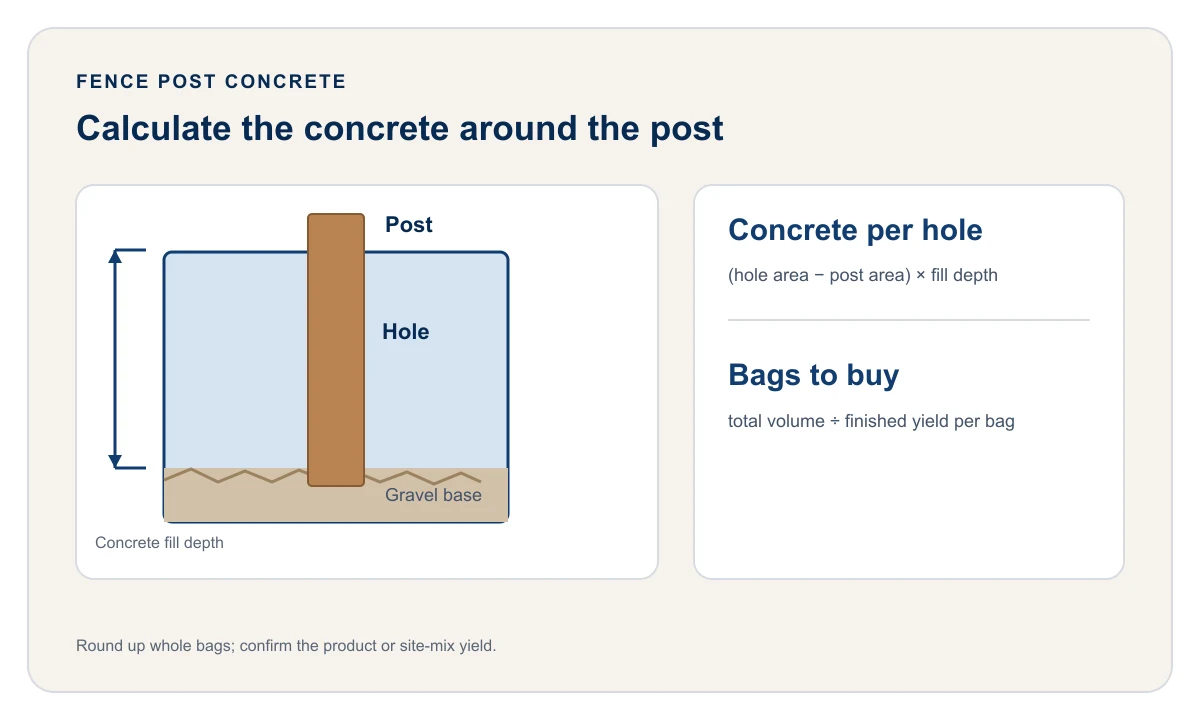
Work out exactly how much concrete your fence-post footings need — as a precise volume, an “equivalent bags” figure, and a whole-bag shopping list that won’t leave you short mid-pour. This is a material quantity calculator: it doesn’t price concrete, set frost-safe depth, or check structural adequacy.
How to use this calculator
- Measurement units — feet / inches (default) or metres / millimetres. Switch any time; your numbers convert automatically.
- Post count — enter it directly, or choose Calculate from fence length and spacing and give the run length and target spacing; the post count updates live.
- Hole shape and size — round (diameter) or square (width), the total hole depth, and an optional gravel base depth.
- Post shape and size — round (diameter) or square (width). The tool checks the post fits the hole, including the diagonal of a square post in a round hole.
- Bag size — defaults to a 30 kg bag; pick another (25 kg, or 40–80 lb) to refill the yield, or choose Custom.
Press Calculate for the full breakdown.
The formula
For each footing, concrete needed is the hole volume minus the buried post’s volume minus any gravel base:
- Ahole
- cross-sectional area of the hole
- Apost
- cross-sectional area of the buried post
- dfill
- depth actually filled with concrete
- dhole
- total hole depth
- dgravel
- gravel base depth (0 if none)
The whole project and the exact bag count:
What you buy:
- Mixed and poured together:
⌈ bagsequivalent⌉— round the project total up once. - Whole bags per hole:
⌈ Vconcrete÷ Ybag⌉ × nposts— round each footing up first.
Fence run to post count
Worked example — frost-depth footing
An 80 ft fence, posts every 8 ft. Footings are 12 in. diameter, 42 in. deep (frost-appropriate), with a 4 in. gravel base; posts are 4x4 (3.5 in. actual). Using 60 lb bags at ~0.45 ft³ yield:
| Step | Value |
|---|---|
Posts: ceil(80 / 8) + 1 |
11 |
Fill depth: 42 − 4 |
38 in. = 3.167 ft |
Hole area: π × (6/12)² |
0.785 ft² |
Post area: (3.5/12)² |
0.085 ft² |
Concrete per footing: (0.785 − 0.085) × 3.167 |
≈ 2.2 ft³ |
Project total: 2.2 × 11 |
≈ 24.4 ft³ |
Equivalent bags: 24.4 / 0.45 |
≈ 54.2 |
Buy (mixed together): ceil(54.2) |
55 bags |
Buy (per hole): ceil(2.2 / 0.45) × 11 = 5 × 11 |
55 bags |
| Total dry mix (55 × 60 lb) | 3,300 lb |
Compare that with a shallow, mild-climate footing at 24 in. of concrete depth (~1 ft³ per hole): the extra depth alone more than doubles the concrete per post. That’s why local frost-depth guidance matters more here than hole diameter.
Common bag sizes and yields in Canada
Retailers stock both metric and imperial bags. The presets draw on SAKRETE Canada’s concrete-mix product information and QUIKRETE’s technical data sheet, both checked September 1, 2026. Yields are approximate; check the figure printed on your product.
| Bag | Approx. yield |
|---|---|
| 25 kg | 0.42 ft³ (11.9 L) |
| 30 kg | 0.50 ft³ (14.2 L) |
| 40 lb | 0.30 ft³ |
| 50 lb | 0.375 ft³ |
| 60 lb | 0.45 ft³ |
| 80 lb | 0.60 ft³ |
Typical hole and post dimensions
Common starting points, not a structural specification — confirm frost depth and hole size with your local building department.
| Fence | Post | Hole diameter | Hole depth |
|---|---|---|---|
| 4 ft, mild climate | 4x4 | 8–10 in. | 24 in. |
| 6 ft privacy, mild | 4x4 | 10–12 in. | 30–36 in. |
| 6 ft privacy, cold region | 4x4 / 6x6 | 12 in. | 42–48 in. |
| 8 ft / exposed | 6x6 | 12–16 in. | 48 in.+ |
Unit conversions used
Why subtract the post, and why gravel
Concrete only fills the gap around the post; ignoring the post’s volume overstates the concrete by 15–30% for common post/hole sizes. A gravel base keeps water from pooling and freezing directly under the post — a contributor to frost heave — and slightly reduces the concrete volume. It’s optional; set the field to 0 in well-drained soil.
Common mistakes this calculator avoids
- Pricing the full hole volume instead of the concrete around the post.
- Assuming a deep frost footing needs “a couple of bags” like a shallow one — depth drives volume.
- Rounding equivalent bags down.
- Forgetting the end posts —
posts = spans + 1.
Worked planning scenario
Compare two otherwise identical 12 in. round holes around a 4x4 post: one 30 in. deep and one 48 in. deep, with no gravel base. Because the cross-section stays the same, the 48 in. hole needs 60% more concrete, not roughly twice as much. That is enough to make a per-post bag rule carried over from a shallower footing unreliable. Enter the depth required for the actual site; the calculator estimates material quantity but does not decide the frost-safe depth.
Methodology
Material quantity only — the geometric volume of concrete implied by your dimensions, as an exact figure and a whole-bag purchase count rounded up so rounding can’t leave you short. It does not determine frost-safe embedment, soil bearing, or code compliance; those are decisions for your province, municipality, and building department. Confirm your hole dimensions first, then use this calculator for materials.
Want the background rather than a specific calculation? Read our guide to how much concrete a fence post needs — the geometry, a bag-yield table, and worked examples for 1, 10, and 20 posts.
FAQs
Is this the same as a post hole concrete calculator?
Yes — post hole concrete calculator and fence post concrete calculator describe the same task: sizing the concrete for a post footing. In much of Canada that means a deep hole to clear the frost line, not just a wide one.
How many bags of concrete per fence post in Canada?
It depends heavily on hole depth. A shallow, mild-climate hole might need 2–3 bags; a frost-depth hole (42–48 in.) can need 5–6 bags of the same size. For the frost-appropriate worked example below — 12 in. × 42 in. hole, 4 in. gravel, 3.5 in. post, 60 lb bags — it's about 5 bags per hole.
How deep should a fence post hole be for frost heave?
Colder regions call for post footings below the local frost line so freeze-thaw can't push the post out of the ground over winter. Frost depth varies significantly by province and municipality — commonly 4–8 ft in the coldest areas. Check with your local building department; this calculator handles whatever depth you set.
Should I use metric or imperial for a fence project in Canada?
Either. This calculator supports both and switching only changes the display, not your numbers. Lumber and post sizes are still commonly discussed in feet and inches across most of the country, which is why imperial is the default here, with metric one click away.
Do I need gravel under a fence post in a freeze-thaw climate?
Many Canadian installers add 3–4 in. of gravel or crushed stone so water drains away from the post base rather than pooling and freezing under it. It's optional in the calculator — set it to 0 if you're not using one.