Fence Post Concrete Calculator
Work out how much concrete your fence-post holes need — and how many bags to buy — accounting for post displacement and a gravel base.

By Berjin B V
Published Updated
- Calculated posts
- —
- Concrete depth (per hole)
- —
- Hole volume (per hole)
- —
- Post displacement (per hole)
- —
- Net concrete (per hole)
- —
- Total concrete
- —
- Equivalent bags
- —
- Approx. bags per hole
- —
- Recommended purchase
- —
- Total bag weight
- —
Request a Free Fencing Quote
Tell us about your fencing project and location. We'll prepare a quote and send it to you when it's ready — Buildmator prepares these manually, and there's no obligation.
Request a Free Fencing QuoteNot a structural specification
Work out exactly how much concrete your fence-post holes need — as a precise volume, an “equivalent bags” figure, and a whole-bag shopping list that won’t leave you short mid-pour. This is a material quantity calculator: it does not price concrete, size your holes, or check structural adequacy.
How to use this calculator
- Measurement units — pick feet / inches or metres / millimetres. You can switch at any time and your numbers convert automatically.
- Post count — either enter the number of posts directly, or choose Calculate from fence length and spacing and give the run length and target spacing; the tool shows the resulting post count live.
- Hole shape and size — round (enter diameter) or square (enter width), plus the total hole depth and an optional gravel base depth.
- Post shape and size — round (diameter) or square (width). The calculator checks the post physically fits the hole, including the diagonal for a square post in a round hole.
- Bag size — defaults to an 80 lb bag; pick another size to refill the yield, or choose Custom and type your product’s stated yield.
Press Calculate for the full breakdown.
The formula
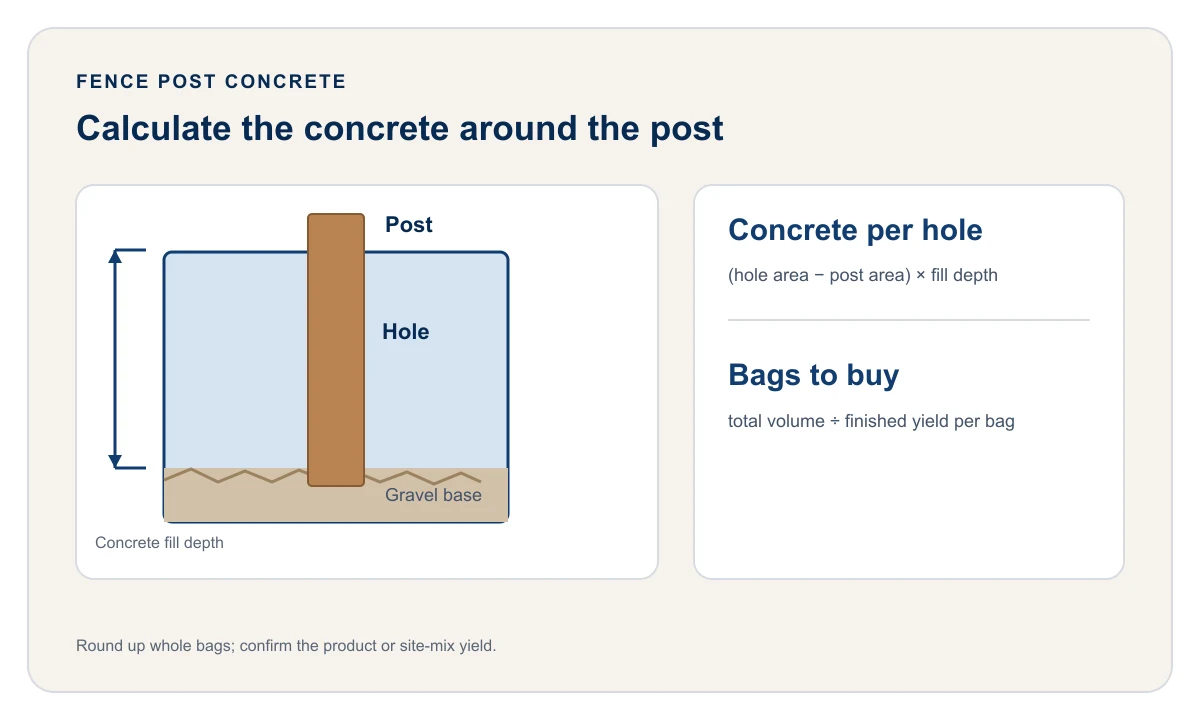
For each hole, the concrete you need is the hole volume minus the part of that volume the buried post occupies, minus any gravel base:
- Ahole
- cross-sectional area of the hole
- Apost
- cross-sectional area of the buried post
- dfill
- depth actually filled with concrete
- dhole
- total hole depth
- dgravel
- gravel base depth (0 if none)
The cross-sectional areas depend on shape:
- w
- diameter (round) or side width (square)
Then the whole project is simply the per-hole figure times the number of posts:
Turning volume into bags
The exact (“equivalent”) number of bags is the total volume divided by one bag’s yield:
The calculator’s Recommended purchase uses the first method. If you’re pouring a bag at a time per hole with no shared mixing, use the second:
- Mixed and poured together: round the project total up once —
ceil(bagsequivalent). Leftover mix from one hole covers the start of the next, so this is the smaller, realistic shopping number. - Whole bags per hole: round each hole up first, then multiply —
ceil(Vconcrete÷ Ybag) × nposts. Safer if you’re not sharing a mix between holes, at the cost of some extra material.
Fence length to post count
- Lfence
- total run length
- starget
- maximum spacing between posts
Rounding the division up guarantees the last gap is never wider than your target, and the + 1 puts a post at each end of the run.
Worked example — round hole, 4x4 post
A 120 ft fence with posts every 8 ft. Holes are 10 in. diameter, 30 in. deep, with a 4 in. gravel base; posts are 4x4 (3.5 in. actual). Using 80 lb bags at ~0.6 ft³ yield:
| Step | Value |
|---|---|
Posts: ceil(120 / 8) + 1 |
16 |
Fill depth: 30 − 4 |
26 in. = 2.167 ft |
Hole area: π × (5/12)² |
0.545 ft² |
Post area: (3.5/12)² |
0.085 ft² |
Concrete per hole: (0.545 − 0.085) × 2.167 |
≈ 1.0 ft³ |
Project total: 1.0 × 16 |
≈ 16 ft³ |
Equivalent bags: 16 / 0.6 |
≈ 26.6 |
Buy (mixed together): ceil(26.6) |
27 bags |
Buy (per hole): ceil(1.0 / 0.6) × 16 = 2 × 16 |
32 bags |
| Total dry mix (27 × 80 lb) | 2,160 lb |
Worked example — square hole, round post
A 60 ft run, posts every 6 ft, 12 in. square holes 36 in. deep, no gravel, 4 in. diameter round steel posts. Using 60 lb bags at ~0.45 ft³:
| Step | Value |
|---|---|
Posts: ceil(60 / 6) + 1 |
11 |
Hole area: (12/12)² |
1.0 ft² |
Post area: π × (2/12)² |
0.087 ft² |
Concrete per hole: (1.0 − 0.087) × 3.0 |
≈ 2.74 ft³ |
Project total: 2.74 × 11 |
≈ 30.1 ft³ |
Equivalent bags: 30.1 / 0.45 |
≈ 66.9 |
| Buy (mixed together) | 67 bags |
Common US bag sizes and yields
Yields are approximate cured-concrete volume. The common 40–80 lb presets follow QUIKRETE’s Concrete Mix technical data sheet, checked September 1, 2026. Product and mix design still matter, so check the figure printed on your own bag.
| Bag | Approx. yield | Bags per 1 ft³ |
|---|---|---|
| 40 lb | 0.30 ft³ | 3.3 |
| 50 lb | 0.375 ft³ | 2.7 |
| 60 lb | 0.45 ft³ | 2.2 |
| 80 lb | 0.60 ft³ | 1.7 |
Typical hole and post dimensions
These are common starting points, not a structural specification. Frost depth, soil, fence height, and wind exposure all change what a safe hole actually needs — check your local building department.
| Fence | Post | Hole diameter | Hole depth |
|---|---|---|---|
| 4 ft picket | 4x4 | 8–10 in. | 24 in. |
| 6 ft privacy | 4x4 | 10–12 in. | 24–36 in. |
| 6 ft privacy (frost) | 4x4 / 6x6 | 12 in. | 36–48 in. |
| 8 ft / windy site | 6x6 | 12–16 in. | 36–48 in. |
A widely used starting rule is a hole diameter around three times the post width and an embedment around one-third to one-half of the above-ground height. It is not a structural specification; frost, soil, wind, and the fence system can require something different.
Unit conversions used
Why subtract the post?
A fence post doesn’t need a solid plug of concrete — it needs the annular gap between the post and the sides of the hole filled. Ignoring the post’s own volume overstates the concrete by the size of the post: for a 4x4 in a 10 in. hole that’s about 15% too much; for a 6x6 in a 12 in. hole, closer to 30%.
Why a gravel base helps
A few inches of compacted gravel or crushed stone under the post:
- keeps the end grain of a wood post out of standing water, slowing rot from below;
- gives water a path away from the post in freeze-thaw climates, reducing frost heave;
- slightly reduces the concrete volume, since it fills depth that would otherwise be concrete.
It’s optional, and some installers skip it in well-drained soil. Set the field to 0 if you’re not using one.
Common mistakes this calculator avoids
- Pricing the full hole volume instead of the concrete that actually goes in around the post.
- Assuming yield from bag weight. An 80 lb bag of one product and a 60 lb bag of another can yield nearly the same volume.
- Rounding equivalent bags down. 1.4 bags is not 1 bag — the calculator shows the true figure and a separate whole-bag purchase count.
- Forgetting the end posts.
posts = spans + 1, notspans.
Worked planning scenario
Use the 120 ft example above: 16 posts, 10 in. round holes, 30 in. deep, with a 4 in. gravel base. The calculated total is about 16 ft³, or 26.6 equivalent 80 lb bags. That becomes 27 bags when the project volume is rounded up once, compared with 32 bags when every hole is rounded to two whole bags. These figures assume the dug holes match the dimensions entered. If roots, loose soil, or an uneven auger make some holes wider, measure the actual holes and recalculate rather than treating the fraction in the 27th bag as a general waste allowance.
Methodology
This tool computes material quantity only — the geometric volume of concrete implied by your dimensions, shown as an exact figure and a whole-bag purchase count rounded up so rounding can’t leave you short. It does not evaluate structural adequacy, frost-safe embedment, soil bearing, or code compliance; those depend on your site and local regulations. Choose (or confirm) your hole dimensions first, then use this calculator for materials.
Want the background rather than a specific calculation? Read our guide to how much concrete a fence post needs — the geometry, a bag-yield table, and worked examples for 1, 10, and 20 posts.
FAQs
Is this the same as a post hole concrete calculator?
Yes. A fence post concrete calculator and a post hole concrete calculator answer the same question — how much concrete, and how many 40, 50, 60, or 80 lb bags, a set of post holes needs once you subtract the space the post itself takes up. This tool does both.
How many bags of concrete per fence post?
For a common 10 in. diameter, 30 in. deep hole (4 in. gravel base) with a 4x4 post, one hole needs about 1.0 ft³ of concrete — roughly 1.7 of a 0.6 ft³ 80 lb bag, so you buy 2 bags per hole if you pour holes separately. Across a whole project, the shared-mix total is lower because leftover mix from one hole covers the next.
How much concrete do I need for a 4x4 fence post?
A 4x4 post is 3.5 in. actual. In a 10 in. round hole 24 in. deep below any gravel, that's about 0.9 ft³ of concrete per hole. Deeper holes (frost areas) or wider holes raise it quickly — the calculator does the exact figure for your dimensions.
Do I need a gravel base under a fence post?
Some fence systems use 2–4 in. of compacted gravel at the bottom of the hole so the post end is not sitting in collected water. It is optional in the calculator; follow the post or fence manufacturer's instructions and set the field to 0 if your design does not use gravel.
How deep should a fence post hole be?
Hole depth depends on fence height, post system, soil, wind, and local frost requirements. A one-third to one-half embedment is a common starting rule, not a design standard. This calculator does not set depth for you — confirm it against manufacturer instructions and local requirements, then use the tool for materials.
Should I use fast-setting concrete or regular mix?
Fast-setting (post) mix can be poured dry into the hole and soaked, which is quicker for a few posts. Standard concrete mix is mixed first and is more economical for a long run. Yields differ by product, so enter the yield printed on your bag rather than assuming.