How Much Concrete Do You Need Per Fence Post?

By Berjin B V
Published Updated
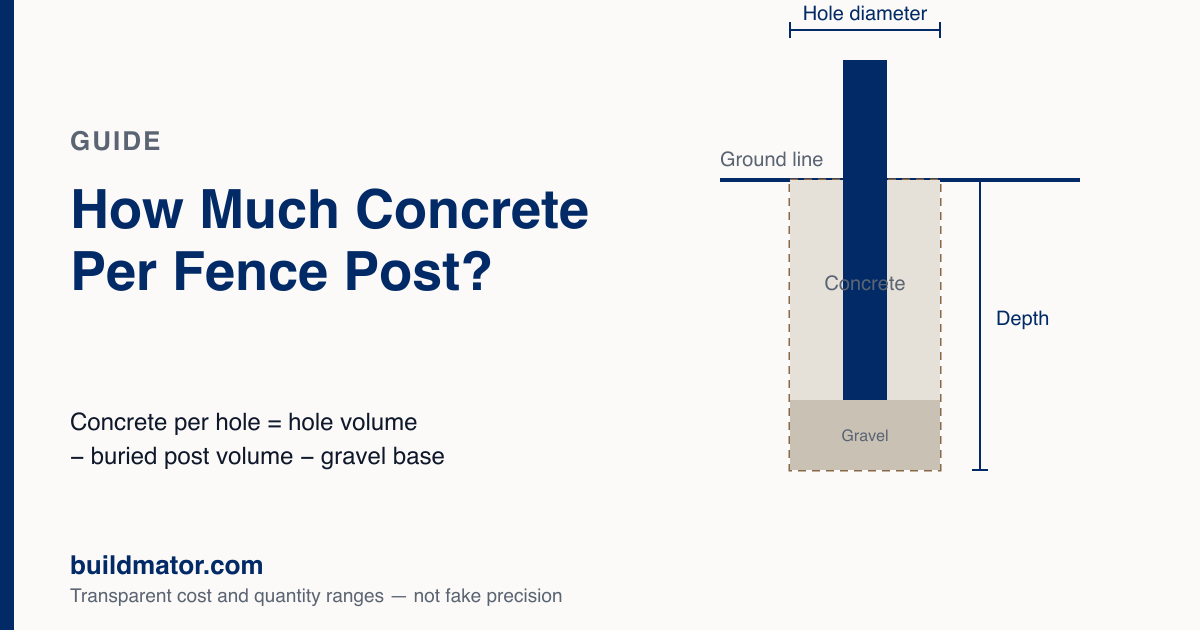
A fence post in a common 10-inch wide, 30-inch deep hole with a 4x4 post needs about 1.15 cubic feet (≈33 litres) of concrete — roughly two 80 lb bags if you set posts one at a time. The concrete only fills the gap around the post, not the whole hole, so the post's own size reduces it; a gravel base, if you add one, trims it further.
Deeper holes change this fast: a 42-inch frost-depth hole in the same diameter needs more than double. To get a figure for your own hole and post, and a bag count for the bag size you're buying, use the Fence Post Concrete Calculator. The rest of this guide shows exactly how that number is worked out.
How Much Concrete Is Needed Per Fence Post?
Start with the volume of the hole, subtract the part of that volume the buried post occupies, and subtract any gravel base. What's left is the concrete.
- Ahole
- cross-section of the hole (see below)
- Apost
- cross-section of the buried post
- dfill
- depth actually filled with concrete
Cross-section depends on shape:
For the common example — 10-inch round hole, 30 inches deep, no gravel base, 3.5-inch (4x4) square post:
- Fill depth: 30 in (2.5 ft) — the full hole, no gravel base
- Hole area: π × (5 ÷ 12)² = 0.55 ft²
- Post area: (3.5 ÷ 12)² = 0.09 ft²
- Concrete per hole: (0.55 − 0.09) × 2.5 ≈ 1.15 ft³
That's about 32.6 litres. Ignoring the post would overstate it by roughly 15%.
How Many Bags of Concrete Do You Need Per Fence Post?
Divide the concrete volume by one bag's yield. The lb-bag figures below match the yields on QUIKRETE's Concrete Mix data sheet (source: QUIKRETE — Concrete Mix No. 1101 Technical Data Sheet); yield still varies by product, so treat them as common approximations, not guarantees.
| Bag | Approx. yield | Holes covered (1 ft³ hole) |
|---|---|---|
| 80 lb bag | 0.6 ft³ / 17 L | 0.6 of a hole |
| 60 lb bag | 0.45 ft³ / 12.7 L | 0.45 of a hole |
| 50 lb bag | 0.375 ft³ / 10.6 L | 0.38 of a hole |
| 40 lb bag | 0.3 ft³ / 8.5 L | 0.3 of a hole |
Approximate yield. Confirm the yield printed on your product packaging.
So one hole (1.15 ft³) is about 1.9 of an 80 lb bag. You can't buy a fraction of a bag, so you buy2 per hole when pouring holes separately.
Fence Post Concrete Mix: What Should You Use?
Two options do the job. Fast-setting (post) mix is poured into the hole dry and soaked with water — you can brace the post and keep working the same day, which suits a handful of posts. Standard concrete mix is combined with water first and is more economical over a long run, but you wait for it to cure before loading the post. Both are sold by the bag in the sizes above; enter whichever product's stated yield you're using.
What Size Hole Should You Dig for a Fence Post?
This is a structural decision, not a concrete-quantity one, and it depends on fence height, wind exposure, soil, and local frost depth. Buildmator doesn't set it for you — choose the hole first, then calculate concrete. The rules of thumb below are a starting point; confirm against your local building department.
Hole diameter / width
A common guideline is a hole about three times the post's width — so roughly a 10–12 inch hole for a 4x4 post, 14–18 inches for a 6x6. A wider hole gives the concrete more bearing area but uses a lot more material, since volume grows with the square of the diameter.
Hole depth
Roughly one-third to one-half of the post's above-ground height is a common guideline, and in freeze-prone regions the hole must reach below the locally specified frost depth. Depending on the location, that can require a much deeper hole than the 30-inch example on this page. Depth is a major driver of concrete volume.
Concrete for Common Fence Post Sizes
All three use the same 30-inch deep hole, no gravel base, so you can see how post size and hole diameter interact.
| Post | Hole | Concrete per hole |
|---|---|---|
| 4x4 (3.5 in) | 10 in round | 1.15 ft³ |
| 6x6 (5.5 in) | 14 in round | 2.15 ft³ |
| 4 in round | 10 in round | 1.15 ft³ |
A 6x6 post is bulkier, but a 6x6 job usually means a wider hole, and the wider hole wins — it needs more concrete overall, not less. A round post of the same nominal size as a square one displaces less (a circle is smaller than the square around it), so it leaves slightly more room for concrete.
Should You Add Gravel Below a Fence Post?
A few inches of compacted gravel under the post keeps the end of a wood post out of water that may collect at the bottom of the hole. It also trims the concrete slightly, because it fills depth that would otherwise be concrete. Whether a gravel base is appropriate depends on the post system and soil:
- No gravel, 30 in hole: 1.15 ft³ per hole
- 4 in gravel, 30 in hole: 1 ft³ per hole
It's optional — many installers skip it in free-draining soil, so the calculator starts with no gravel base. Add one in the gravel field if you're using it.
Quick-Set Concrete for Fence Posts
Fast-setting post mix uses the same volume calculation — you still need the same cured-concrete volume around the post. Some products are made for dry placement followed by water; others require mixing first. Follow the instructions and curing time on the bag, and enter that product's stated yield rather than estimating it from bag weight.
How to Calculate Concrete for a Fence Post
- Work out the concrete per hole with the formula above.
- Multiply by the number of posts for the project total.
- Divide the total by your bag's yield for the exact bag count.
- Round up to whole bags for what you buy.
If you know your fence length but not the post count, the calculator works it out as ceil(length ÷ spacing) + 1 — a post at each end and one at every full span. A 120 ft run at 8 ft spacing is 16 posts.
Worked Examples
All use the common hole (10 in round, 30 in deep, no gravel base), a 4x4 post, and 80 lb bags at 0.6 ft³, poured as one shared mix.
One post
- Concrete: 1.15 ft³
- Equivalent bags: 1.9
- Buy: 2 × 80 lb bags
10 posts
- Total concrete: 11.5 ft³
- Equivalent bags: 19.2
- Buy: 20 × 80 lb bags (1600 lb total)
- Per-hole pour: also 20 here — each hole is 1.9 of a bag, which rounds to 2, and 2 × 10 = 20
20 posts
- Total concrete: 23 ft³
- Equivalent bags: 38.4
- Buy: 39 × 80 lb bags
How Many Concrete Bags Should You Buy?
Buy the rounded-up whole-bag figure, never the equivalent-bags number. For the 10-post project above, the exact requirement is 19.2 bags — but you can only buy 20. The extra part-bag is your margin for a hole that's a little wider than planned or mix that's a little wet. If you're pouring each hole with its own bag and not sharing a mix, round each hole up first — with a bag that doesn't divide evenly this adds up. With 50 lb bags (0.375 ft³) the 10-post job is 40 bags that way, versus 31 mixed as one batch.
Mix for the Whole Project vs Whole Bags Per Hole
Mix for the whole project treats the concrete as one pour: you mix continuously and a part-bag left from one hole starts the next, so you round up only once at the end. This is the lower, realistic number if you have a mixer or a wheelbarrow going.
Whole bags per hole rounds each hole up on its own, then multiplies. This is the figure to use if you're dropping one bag per hole with no shared mixing — it guarantees no hole runs short, at the cost of some spare material. With 50 lb bags, the 10-post example is 40 bags this way, versus 31 mixed as one batch.
Planning for Holes That Are Not Identical
Consider the 10-post example above. The calculated need is 19.2 equivalent 80 lb bags, so the whole-bag purchase is 20. That rounding covers only the fraction needed to reach the next whole bag; it is not a separate waste allowance. If the dug holes are wider or deeper than the planned dimensions, measure them again or add a margin that reflects the actual site before buying.
The reverse problem is rounding every hole up separately when you can share mixed concrete across the run. On a long fence, that can produce a much larger shopping number than rounding the total project volume once. Choose the calculator's pour method that matches how you will work.
How the Numbers in This Guide Are Built
Every figure here is produced by the same calculation engine that runs the calculator — hole volume minus post volume minus any gravel base — not pulled from a bag manufacturer's rule of thumb. Bag yields are common published approximations and are flagged as such; the number that matters for your purchase is the yield printed on the product you buy. This guide was last reviewed on 2026-09-22. The assumptions and editorial process are on the methodology page.
Does Fence Type Change How Much Concrete You Need?
Only indirectly. A heavy wood privacy fence, a light chain-link fence, and a vinyl fence tend to use different post sizes, hole diameters, and depths, and those dimensions are what change the concrete. Buildmator calculates from the hole and post geometry you enter, so if two fences use the same hole and post, they need the same concrete regardless of the material bolted to them.
Fence Post Concrete Calculator
For your own dimensions and bag size — with the equivalent bags, the approx. bags per hole, the recommended purchase, and the total bag weight — use the Fence Post Concrete Calculator. Use the UK fence concrete calculator, Canada fence concrete calculator, Australia fence concrete calculator, or India fence concrete calculator for region-appropriate bag sizes. See the methodology for the assumptions behind it.
Sources and data notes
These manufacturer and technical references support the regional bag-yield and site-mix assumptions discussed in this guide.
- Concrete Mix No. 1101 Technical Data Sheet — QUIKRETEUnited States: Approximate mixed-concrete yield by bag size · Checked September 1, 2026
- SAKRETE Concrete Mix Product and Yield Information — SAKRETE CanadaCanada: Approximate mixed-concrete yield by bag size · Checked September 1, 2026
- Concrete Mix No. 1101 Technical Data Sheet — QUIKRETECanada: Approximate mixed-concrete yield by bag size · Checked September 1, 2026
- Postcrete Product Information — Tarmac Blue CircleUnited Kingdom: Post-setting product size and application guidance · Checked September 1, 2026
- Post Hole Concrete Mix — BoralAustralia: Post-setting product size and application guidance · Checked September 1, 2026
- Concrete Mix and Rapid Set Product Guidance — Cement AustraliaAustralia: Approximate mixed-concrete yield by bag size · Checked September 1, 2026
- What Is an Ideal M15 Concrete Ratio? — UltraTech CementIndia: Site-mixed M15 cement quantity · Checked September 1, 2026
Published figures and products can change. Confirm current pricing, coverage, yield, and instructions with the supplier or product packaging before buying materials.
Frequently Asked Questions
How much concrete do you need per fence post?
For a common 10-inch diameter, 30-inch deep hole with a 4x4 post, about 1.15 cubic feet (≈33 litres) of concrete per hole — the hole volume minus the space the buried post takes up. A gravel base, if you add one, trims it a little further. Wider or deeper holes, or holes in frost country, need considerably more. The calculator gives the exact figure for your dimensions.
How many bags of concrete do you need per fence post?
That 1.15 cubic feet of concrete is about 1.9 of a 0.6 ft³ 80 lb bag — so two 80 lb bags per hole if you pour holes one at a time. Across a whole fence you buy fewer, because leftover mix from one hole covers the start of the next. A 60 lb bag (~0.45 ft³) covers roughly two-thirds of a hole; a 40 lb bag (~0.30 ft³) less than half.
How much concrete for a 4x4 fence post?
A 4x4 post is 3.5 inches actual. In a 10-inch round hole 30 inches deep, that's about 1.15 ft³ of concrete per hole. A 6x6 post (5.5 inches) in a 14-inch hole needs about 2.15 ft³ — the wider hole outweighs the bulkier post.
Does bag weight tell you the yield?
No. Yield — the cured concrete volume one bag makes — depends on the product and mix design, not just its weight. Use the yield printed on the bag you're buying; the calculator presets are only starting points.
Should you round the bag count up or down?
Always up for what you buy. The calculator shows two numbers: the exact 'equivalent bags' (for example 12.4) so you can see the true requirement, and a whole-bag 'recommended purchase' rounded up (13) so a rounding decision never leaves you short mid-pour.
Does the type of fence change how much concrete you need?
Not in the calculation. Wood, vinyl, chain link, aluminium, and composite fences tend to use different post sizes and hole depths, and those dimensions change the concrete — but Buildmator calculates from the actual hole and post geometry you enter, not from a fence-type label.