Epoxy Flooring Cost Calculator
Estimate an installed epoxy flooring budget as a transparent cost range, not a single guessed number — enter your own local pricing for a tighter estimate.

By Berjin B V
Published Updated
Prices can vary based on local labor costs and material pricing in some regions.
Get a More Accurate Local Estimate
Get a more accurate estimate based on your location. Add your postal code and a few details about your floor's condition — we'll refine this range using regional pricing where we have verified data.
Get a More Accurate Local Estimate- Base system
- Preparation
- Add-ons
- Contingency
Estimate only, not a quote
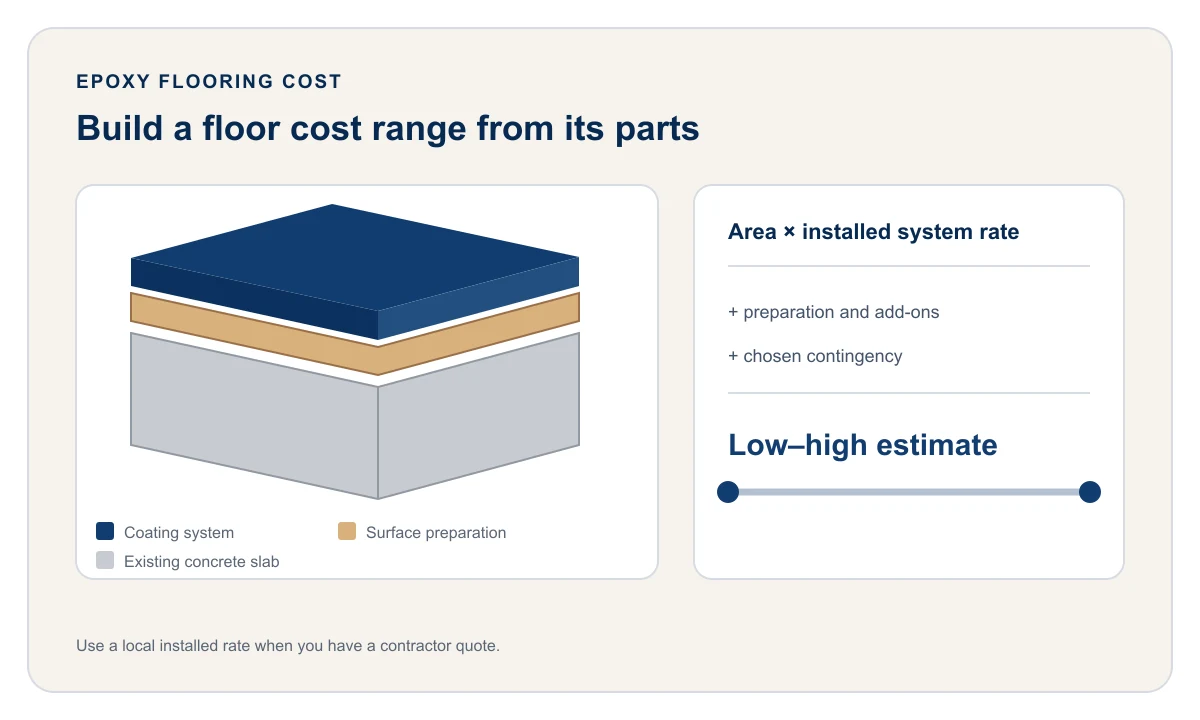
Estimate an installed epoxy flooring budget as an honest low-to-high range — coating system, slab repair, add-ons, and a contingency buffer — instead of a single guessed number. Buildmator’s researched range loads by default; switch to your own local installed rate if you have one. The location-adjusted version applies a state or territory construction-cost proxy based on the available capital-city benchmark.
How to use this calculator
- Measurement units — square metres or square feet.
- Area — enter the total, or switch to Calculate from length × width for a live figure.
- Project type — garage, workshop, commercial, etc. Context for a later quote; it doesn’t change the maths.
- Coating system — the systems below. Picking one loads its researched per-m² range, with sources named; the self-levelling figure is marked as modeled.
- Floor condition — how much prep the slab needs. Known work (grinding, crack repair, coating removal) adds cost; an unconfirmed moisture issue only widens the top of the range.
- Optional add-ons — flakes, a clear topcoat, crack repair, old-coating removal, a moisture barrier. Priced automatically; overlapping selections are disabled so nothing is double-counted.
- Pricing source — use Buildmator’s researched range, or Enter my local price per m².
- Contingency allowance — a percentage buffer (default 10%).
The formula
- C
- estimated installed cost (a low and a high figure)
- A
- floor area
- rlow..high
- base coating rate per m², low and high
- rprep & add-ons
- per-m² rates for the floor-condition adjustment and any add-ons
- p
- contingency allowance, percent
The effective installed rate shown with the result is the total divided back by area:
A minimum job charge can apply to a small area. The calculator does not add one automatically, so ask the installer whether a minimum changes the result.
On the location-adjusted version, one state or territory construction-cost proxy is applied — exactly once — to researched (not user-entered) pricing. Each factor is based on the available capital-city benchmark, so it is not postcode-level epoxy contractor pricing:
Epoxy system cost per m² (Australia)
Installed supply-and-install, sound slab assumed. The Australian planning ranges draw on SuperTrades’ cost calculator and guide and Floor X Industries’ warehouse-flooring guide. The metallic range averages Metal and Flake, Geelong Concrete Coatings, and Yakka Labour (checked October 13, 2026). Only Yakka explicitly includes GST; confirm the tax and preparation scope of local quotes. Pick a system above to load its researched low-to-high figure; the calculator’s pricing data identifies the source used for each system.
| System | Installed $/m² | Typical use |
|---|---|---|
| Basic (water-based) | $42 – $59 | Light-duty, budget garages |
| High-build (solvent-based) | $64 – $86 | Garages, workshops |
| Decorative flake | $73 – $106 | The common Australian garage floor |
| Self-levelling | $63 – $103 | Smooth, level floors (modeled figure) |
| Metallic | $100 – $170 | Feature floors, retail |
| Specialised / industrial | $39 – $75 | Chemical- or abrasion-resistant systems |
The epoxy flooring cost guide explains what separates these systems.
What adds to the base rate
Brushworks’ epoxy-flooring guide describes how slab condition and preparation affect the installed price (checked August 25, 2026). The calculator applies the following researched or modeled adjustments:
| Floor condition | Adds (approx. $/m², AUD) |
|---|---|
| Light prep needed | +5% of the base rate |
| Grinding required | $13 – $25 |
| Cracks or repairs | +15% of the base rate |
| Old coating to remove | $10 – $60 |
| Moisture issue / unknown | widens the top of the range only ($16 – $28 if confirmed) |
Optional add-ons are priced the same way, and overlapping selections are disabled so nothing is charged twice.
Worked example — flake double garage
36 m² double garage, decorative flake, good slab, 10% contingency:
| Step | Value |
|---|---|
Base: 36 × $73..$106 |
$2,628 – $3,816 |
| Floor condition (good) | + $0 |
| Subtotal | $2,628 – $3,816 |
Contingency: × 1.10 |
$2,891 – $4,198 |
| Midpoint | ≈ $3,544 |
| Effective installed rate | $80.30 – $116.60 / m² |
Worked example — water-based with repair, small area
12 m² utility room, water-based epoxy, “cracks or repairs”, 10% contingency:
| Step | Value |
|---|---|
Base: 12 × $42..$59 |
$504 – $708 |
| Cracks or repairs: +15% of base | $76 – $106 |
| Subtotal | $580 – $814 |
Contingency: × 1.10 |
$638 – $895 |
The per-m² maths gives roughly $640–$900. A contractor’s total may be higher if a minimum job charge applies; ask rather than assuming a fixed amount.
What actually drives the price
- Slab repair and grinding. A sound, ground slab coats for the base rate; a pitted or cracked one doesn’t.
- Moisture. Moisture moving through a slab can interfere with adhesion. Ask what testing and limits the specified coating requires before assuming a barrier is needed.
- Job size. A minimum charge can affect a small area, while a larger open floor may have a lower rate per m².
- State. Labour and transport vary across NSW, VIC, QLD, WA and the rest. The location-adjusted estimate uses a sourced general construction-cost proxy based on the available capital-city benchmark for each state or territory.
Ways to keep the cost down
- Coat a newer slab before oil, cracks, and an old sealer make prep expensive.
- Ask whether combining a small room with an adjoining area changes the minimum or mobilisation charge.
- Choose flake or solid-colour high-build over metallic for durability without the premium.
- Get itemised quotes — the coating rate is similar; the prep and repair lines aren’t.
Worked planning scenario
Take the illustrative 12 m² room in the worked example above. Its per-m² calculation is roughly $640–$900, but a contractor may apply a minimum job charge that produces a higher quote. The calculator does not add that charge automatically. Ask whether a minimum applies and whether combining an adjoining area into the same scope changes the total; do not assume the larger project will cost only the minimum.
Methodology
Base per-m² ranges draw on the Australian supply-and-install guides linked beside the figures above; the self-levelling figure is modeled. Floor-condition figures reuse researched AUD/m² data where an itemised number exists and a documented percentage of the base rate where it doesn’t. Every result is a planning range, not a quote — see the full methodology; real quotes vary by site, finish, and contractor.
Planning a budget rather than a specific floor? Read our epoxy flooring cost guide — cost per square foot by coating system, how slab condition changes the price, and worked examples by project size.
FAQs
What is the typical epoxy flooring cost in Australia?
Supply-and-install pricing generally runs about $42–$170 per m²: roughly $42–$59 for water-based epoxy, $64–$86 for solvent-based / high-build, $73–$106 for flake, and $100–$170 for metallic. Slab repair and a minimum job charge can lift the total for small areas.
How much does an epoxy garage floor cost for a 36 m² double garage?
Around $1,700 for water-based epoxy, $2,700 for solvent-based / high-build, $3,200 for flake, or $5,400 for metallic at the midpoint of each range — before any repair allowance or contingency. The calculator does the exact range for your area and finish.
Does slab repair add to the cost?
Yes. Removing an old coating adds about $10–$60 per m², and crack repair adds roughly 15% of the coating rate, applied before the total is calculated. Choose the matching Floor condition in the calculator and the range widens to cover it.
Is there a minimum job charge for epoxy flooring in Australia?
Some installers apply a minimum job charge to small areas, but the amount varies and this calculator does not add one automatically. Ask about it when pricing a single garage bay or small utility room.
Is the slab preparation included in the quoted rate?
The calculator's coating rates assume a sound, ready-to-coat slab. Check whether grinding, crack repair, coating removal, and moisture treatment are included in each quote. Use the Floor condition and add-on fields for work that is priced separately.
How long does an epoxy garage floor last in Australia?
There is no reliable lifespan from the system label alone. Service life depends on slab preparation, moisture, coating thickness, traffic, exposure, maintenance, and the product specification. Ask installers for the written system build and warranty rather than relying on a generic year range.