Epoxy Flooring Cost Calculator
Estimate an installed epoxy flooring budget as a transparent cost range, not a single guessed number — enter your own local pricing for a tighter estimate.

By Berjin B V
Published Updated
Prices can vary based on local labor costs and material pricing in some regions.
Get a More Accurate Local Estimate
Get a more accurate estimate based on your location. Add your postal code and a few details about your floor's condition — we'll refine this range using regional pricing where we have verified data.
Get a More Accurate Local Estimate- Base system
- Preparation
- Add-ons
- Contingency
Estimate only, not a quote
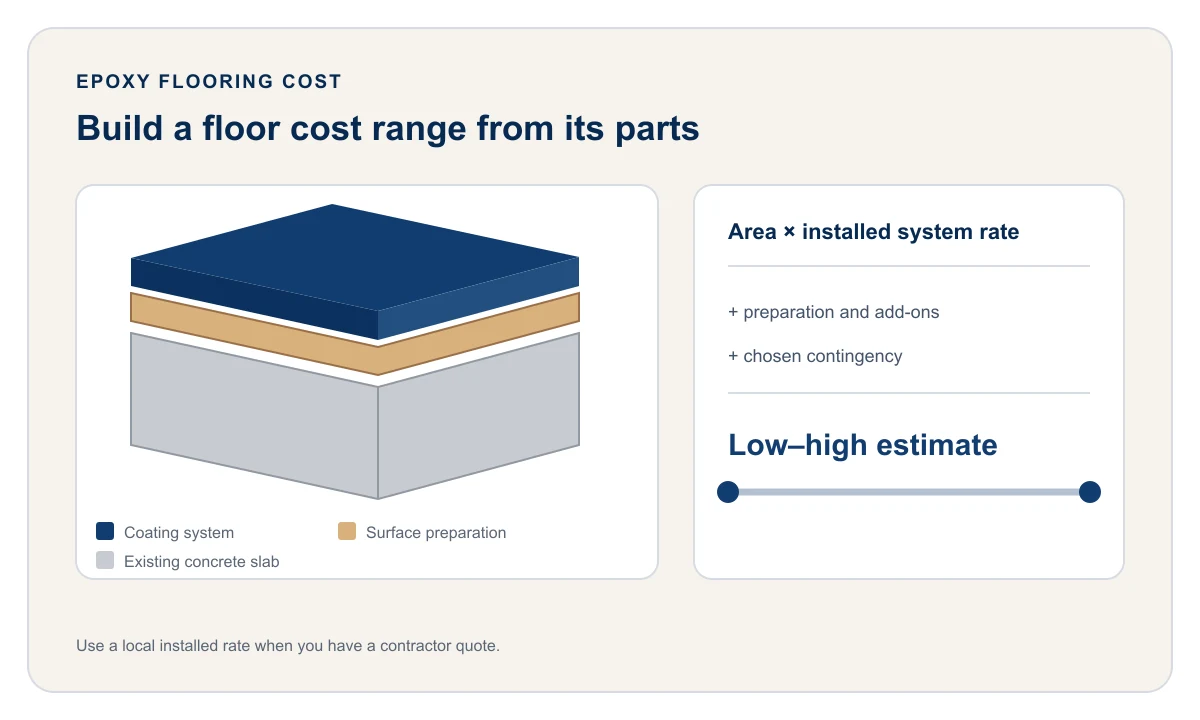
Estimate an installed epoxy flooring budget as an honest low-to-high range — coating system, surface prep, add-ons, and a contingency buffer — instead of a single guessed number. Pricing varies significantly by city in India, so treat the result as a planning starting point. Buildmator’s reference range loads by default; switch to your own local installed rate once you have one. The location-adjusted version applies a sourced general construction-cost adjustment for ten supported metros; other locations use the India-wide planning baseline.
How to use this calculator
- Measurement units — square feet (the common way Indian flooring is quoted) or square metres.
- Area — enter the total directly, or switch to Calculate from length × width for a live figure.
- Project type — garage, residential interior, commercial, warehouse, etc. Context for a later quote; it doesn’t change the math.
- Coating system — the systems below. Picking one loads its researched per-sq-ft range where one exists.
- Floor condition — how much prep the slab needs. Known work adds cost; an unconfirmed moisture issue only widens the top of the range.
- Optional add-ons — flakes, a clear topcoat, crack repair, old-coating removal, a moisture barrier. Priced automatically; overlapping selections are disabled so nothing is double-counted.
- Pricing source — use Buildmator’s reference range, or Enter my local price per sq ft (recommended once you have a city quote).
- Contingency allowance — a percentage buffer (default 10%).
The formula
- C
- estimated installed cost (a low and a high figure)
- A
- floor area
- rlow..high
- base coating rate per sq ft, low and high
- rprep & add-ons
- per-area rates for the floor-condition adjustment and any add-ons
- p
- contingency allowance, percent
The effective installed rate shown with the result is the total divided back by area:
Epoxy system cost per sq ft (India — reference pricing)
The basic-coating starting range combines CoatCraft Solutions’ installed-cost guide, IndiFrame’s per-square-foot guide, and Swaraj Polycoats’ industrial cost breakdown, checked September 22, 2026. Other systems have different source coverage; the high-build figure is modeled rather than a measured market average.
| System | Installed ₹/sq ft | Typical use |
|---|---|---|
| Basic epoxy coating | ₹38 – ₹73 | Utility floors, light-duty garages |
| Self-levelling epoxy | ₹73 – ₹150 | Smooth, level floors; showrooms |
| Decorative flake | ₹97 – ₹170 | Garages, retail |
| High-build / 100% solids | ₹57 – ₹126 | Heavy-duty coatings (modeled figure) |
| Metallic / decorative | ₹130 – ₹300 | Feature floors |
| Anti-slip / ESD / industrial | ₹130 – ₹253 | Wet areas, ramps, electronics/cleanrooms |
On this data: the basic range averages three independent published guides; some other ranges still rely on fewer sources, and the high-build figure is modeled. Pricing across India can differ meaningfully — use this as a rough starting point, then switch to Enter my local price once you have a city quote. PU (polyurethane) concrete is a separate, pricier system (~₹150–₹220 per sq ft) — enter your own rate for that.
What adds to the base rate
| Floor condition | Adds (approx.) |
|---|---|
| Light prep needed | +5% of the base rate |
| Grinding required | +12% of the base rate |
| Cracks or repairs | +15% of the base rate |
| Old coating to remove | ₹10 – ₹25 per sq ft |
| Moisture issue / unknown | +18% on the top of the range only |
Only the old-coating figure has a distinct ₹/sq ft source for India; the others are a documented percentage of the base rate. An uneven slab that needs a levelling screed before coating is a separate, larger cost — get that quoted directly.
Worked example — self-levelling floor
500 sq ft, self-levelling epoxy system, good level slab, 10% contingency, reference pricing:
| Step | Value |
|---|---|
Base: 500 × ₹73..₹150 |
₹36,500 – ₹75,000 |
| Floor condition (good) | + ₹0 |
| Subtotal | ₹36,500 – ₹75,000 |
Contingency: × 1.10 |
₹40,150 – ₹82,500 |
| Midpoint | ≈ ₹61,325 |
| Effective installed rate | ₹80.30 – ₹165 / sq ft |
Worked example — basic coating with grinding
800 sq ft workshop, basic epoxy coating, “grinding required”, 10% contingency:
| Step | Value |
|---|---|
Base: 800 × ₹38.33..₹73.33 |
₹30,664 – ₹58,664 |
| Grinding: +12% of base | ₹3,680 – ₹7,040 |
| Subtotal | ₹34,344 – ₹65,704 |
Contingency: × 1.10 |
₹37,778 – ₹72,274 |
| Midpoint | ≈ ₹55,026 |
| Effective installed rate | ₹47.22 – ₹90.34 / sq ft |
What actually drives the price
- The base slab. A hard, level, cured concrete or IPS floor coats cheaply. A soft, uneven, or freshly cast slab needs grinding or a screed first — often the biggest single cost.
- System type. A thin basic coating is a fraction of the cost of a self-levelling floor, which uses far more material.
- Moisture and dampness. Common on ground-floor and older slabs; a moisture-tolerant primer or barrier adds cost but prevents peeling.
- City. Metro pricing can differ from smaller-city pricing. The location-adjusted estimate uses a sourced general construction-cost proxy for ten supported metros and clearly retains the India-wide baseline elsewhere; it is not PIN-code-level epoxy contractor pricing.
Ways to keep the cost down
- Coat a slab while it’s new, hard, and level — before it’s stained or cracked.
- Choose a basic coating over self-levelling if the floor is already flat and you mainly want dust-proofing and easy cleaning.
- Get the slab checked for dampness early; knowing you don’t need a barrier removes a big source of quote spread.
- Get quotes from two or three installers in your own city and enter the numbers yourself.
Worked planning scenario
Take an illustrative 400 sq ft ground-floor storeroom with an uneven IPS floor and unknown moisture condition. A basic coating rate alone is not a complete scope: grinding, a levelling screed, and a moisture-control primer may be separate decisions after the slab is assessed. The calculator can model grinding and moisture uncertainty, but it does not price a screed or determine which primer is compatible. Get those items quoted directly and enter the resulting local installed rate for a more useful range.
Methodology
Reference per-sq-ft rates draw on Indian installer and cost-guide data linked beside the table above; other systems have different source coverage. These are starting points, not national rates, and high-build is marked as modeled. Only the old-coating floor-condition figure has a distinct ₹/sq ft source; the others are a documented percentage of the base rate. Every result is a planning range, not a quote — see the full methodology and get quotes from installers in your own city before committing.
Planning a budget rather than a specific floor? Read our epoxy flooring cost guide — cost per square foot by coating system, how slab condition changes the price, and worked examples by project size.
FAQs
What is the cost of epoxy flooring per sq ft in India?
As a starting reference: basic epoxy coatings run roughly ₹38–₹73 per sq ft, self-levelling epoxy ₹73–₹150 per sq ft, decorative flake ₹97–₹170, and specialised systems such as anti-slip or ESD flooring ₹130–₹253 per sq ft. Prices vary noticeably by city and installer, so treat these as a starting point, not a national rate.
Does epoxy flooring price vary by city in India?
Yes, materially. Transport, labour rates, and local competition all shift pricing city to city. The basic-coating reference combines three independent guides, including one Maharashtra installer; other systems have different source coverage. Get local quotes before committing.
What's the difference between epoxy and PU flooring cost?
PU (polyurethane) concrete flooring is a different, typically pricier system — roughly ₹150–₹220 per sq ft from the same source — used in heavy-duty industrial and food-processing settings rather than standard coatings. This calculator is for epoxy systems; enter your own rate if you're pricing PU.
Is ESD or anti-slip epoxy worth the extra cost?
It depends on the space. ESD (electrostatic dissipative) flooring is aimed at electronics manufacturing and cleanrooms; anti-slip finishes at wet areas, ramps, and high-safety zones. For a home garage or utility floor, a basic or self-levelling system is usually enough.
Is the surface preparation included in the per-sq-ft rate?
The reference rates assume a sound, level base slab. Grinding, crack filling, or a screed to level an uneven floor are usually quoted separately. Use the Floor condition and add-on fields so the estimate reflects your slab, and confirm heavy repairs with the installer.